
Clarity Doesn’t Come from Thinking Harder


We all know that loop.
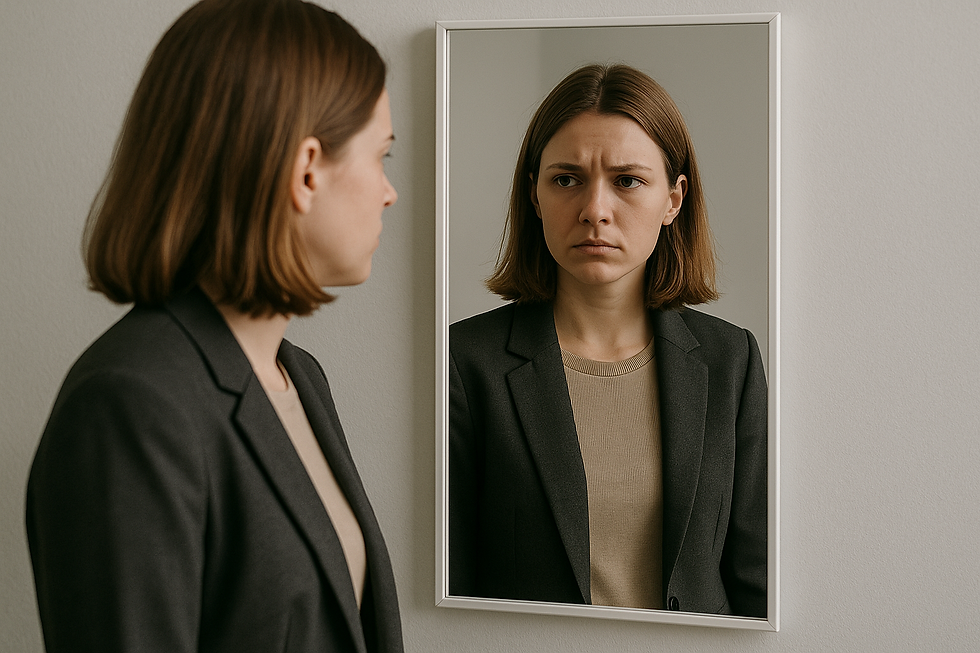
You replay a conversation. Re-analyse a decision. Examine every possible outcome.
And somehow, the more you think, the foggier everything feels.
It feels responsible, even intelligent, to “figure it out.”
But what if clarity isn’t created by effort?
What if clarity begins with honesty?
Why Thinking Isn’t Working
Most professionals don’t struggle because they lack clarity.
They struggle because clarity feels risky.
Overthinking isn’t a flaw.
It’s intelligence without safety.
When your nervous system senses uncertainty, the mind starts scanning for every possible threat.
So you analyse, prepare, predict.
Not because you’re indecisive but because part of you doesn’t yet feel safe to move.
Neuroscientist Dr. Rick Hanson calls this the brain’s “negativity bias.” Its the habit of over-tracking potential danger.
It kept our ancestors alive, but today it keeps brilliant women circling instead of choosing.
The Cost of Avoiding Truth
In coaching, I often meet women who say,
“I just need to think it through a bit more.”
But beneath the thinking, there’s usually something else:
If I admit what’s true, I might have to change something.
Honesty can feel dangerous when your identity, relationships, or career depend on keeping things looking a certain way.
So instead, you strategise.
You “power through."
You keep performing clarity instead of living it.
As Dr. Gabor Maté writes, “The body says no when we ignore our truth.”
That heaviness in your chest.
The fatigue you can’t explain.
The quiet resentment you can’t shake.
Those sensations aren’t failures; they’re signals.
Your system is tired of pretending something still works when it doesn’t.
The Somatic Doorway to Clarity
You can’t think your way out of a survival response.
You have to feel your way through it.
When you notice yourself looping, pause.
Drop your attention from your head into your body.
Unclench your jaw.
Exhale slowly.
Feel your feet on the ground.
Then ask:
What’s true right now: not ideal, not expected, just true?
The body often knows before the mind admits it.
Tightness, heaviness, a sudden release: these are forms of honesty.
Once the body feels safe, you gain clarity naturally.
As Tara Mohr teaches in her Inner Mentor work, wisdom doesn’t shout; it whispers.
You hear it when you stop performing certainty.
Honesty Is Strategy
In leadership, honesty isn’t softness.
It’s precision.
The leaders I work with who create the most trust aren’t the ones with every answer.
They’re the ones who tell the truth early even when it’s uncomfortable.
They say, “Something here feels off,” before it becomes a crisis.
That transparency builds psychological safety in their teams and within themselves.
When you tell yourself the truth about your energy, your boundaries, your workload, your desires, your limits; your decisions become sharper.
You stop managing optics and start managing reality.
Honesty is alignment.
And alignment is clarity.
Clarity doesn’t come from pushing harder.
It comes from telling the truth: gently, honestly, without performance.
If you’re ready to start the new year grounded and clear, I have limited 1:1 coaching spaces available for early 2026.
Email me to book your spot and explore what clarity could make possible for you.



Comments